Šalamoun's Handwritten Prayers
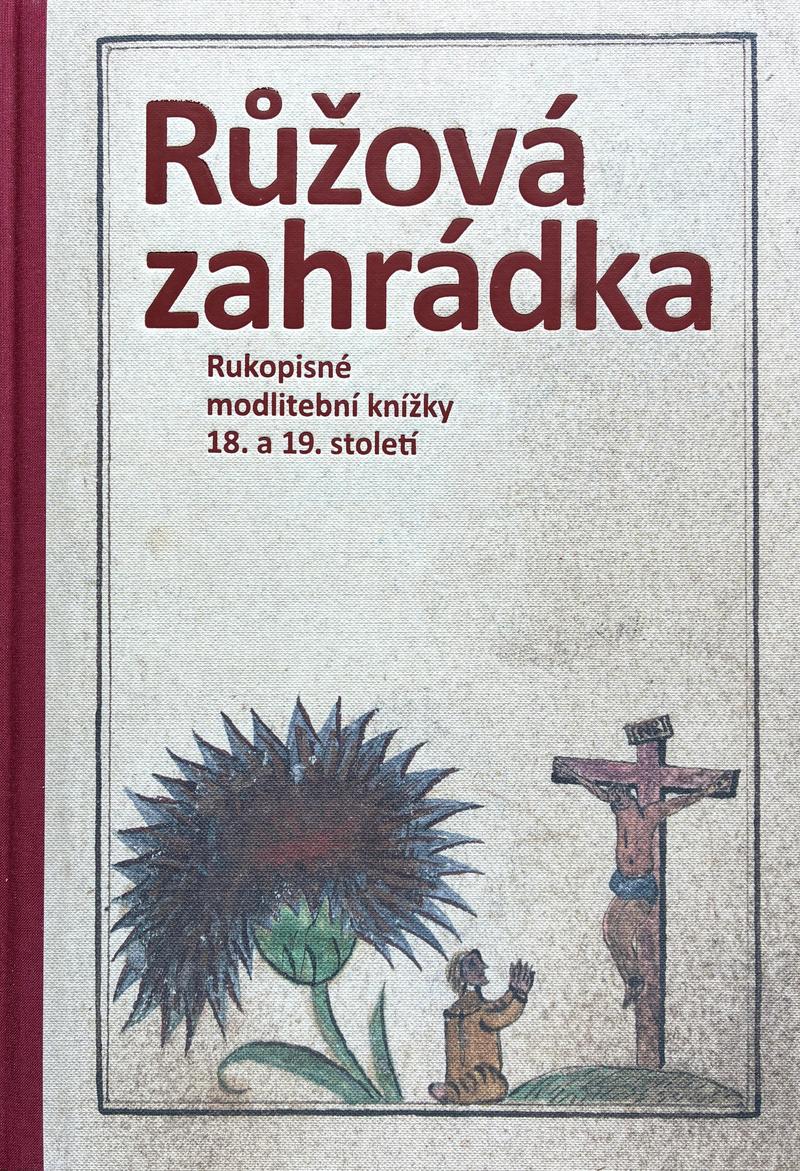
This small collection of prayer booklets from the 18th and 19th centuries, from the estate of Jiří Šalamoun (1935–2022), offers just a glimpse into the picturesque artistic world of handwritten, ornate prayer booklets. These booklets were very dear to Jiří Šalamoun—a highly creative artist whose illustrations blend childlike playfulness, humor, and a sense of the naive, descriptive, and spontaneous. He shared his fascination with these small manuscripts, which help shape the world of the late Baroque, with his friend Jan Poš. Jan Poš was an avid collector of hand-copied and decorated prayer booklets. Over the course of three decades, he amassed some four hundred artifacts, which eventually found their way into the collections of the Olomouc Museum of Art and formed the basis for an exhibition accompanied by the scholarly publication The Rose Garden (1).
As someone close to the Poš family, I myself witnessed several occasions when, during their regular get-togethers, the two gentlemen—enclosed in a shared bubble of admiration for those little books—would delight in them like children, marveling at the original artwork and intricate details of each volume. It was the delight of enchanted connoisseurs, bibliophiles, lovers of poetry and humor—the joy of discovery. These unforgettable scenes clearly showed how a book can become a lifelong pleasure. Jiří Šalamoun was not a true collector of prayer books like Poš. The few copies that are now part of the extensive collection of prayer books at the Moravian Library in Brno (the library will publish a scholarly volume on it in October 2026) are nonetheless a select collection that Šalamoun gathered as a frequent explorer of Prague’s antiquarian bookshops for his own joy and inspiration.
Organizing book exhibitions is a unique and demanding endeavor, because nothing can replace the pleasure of truly experiencing a book as a living, organic whole—the feel of a well-worn cover, the act of touching it, flipping through the pages, the scent of old paper, the emotional impact of the whole, the awareness of how much memory it holds and how vitally precious it was to its original owner, linked to hope, faith… This online exhibition presents selected examples from those few copies of Šalamoun’s collection; however, these are only fragments, selected glimpses of books whose production generally dates roughly between 1750 and 1850. We present eight handwritten books in the Kurent script, six of which are German and two Czech. Two copies date from the 18th century, the others from the first half of the 19th century. The unillustrated manuscript has a distinctive character; based on the type of script, it was created as early as the first half of the 18th century, and it does not contain prayer books but “funeral songs,” featuring meditations and teachings for the time of life and death. Another manuscript book from Šalamoun’s collection does not contain prayer books, but rather illustrated scenes from the Old Testament. (2 – see list of manuscripts). In this online exhibition, the arrangement of reproductions selected from the books in Jiří Šalamoun’s collection focuses on the visual structure and pictorial motifs characteristic of these illuminated manuscripts. A similar classification, as proposed by Jan Poš, was also applied in their presentation at previous museum exhibitions.
All those slender, humble books have long since fulfilled their purpose (who would read in Kurent or Fraktur today?), and have become relics that bear witness to the people and the era of their creation, testifying to the need for a living religious sentiment combined with a need for beauty and joy—yet not beauty imported from elsewhere, but “crafted” directly within the local rural and small-town context. In our country, the term “folk Baroque” is well known, finding expression in the landscape, architecture, painted furniture, ceramics, and glass paintings; yet a book—or rather, an attempt at a “beautiful book”—in a folk context is a rare phenomenon.
This was a widespread cultural phenomenon that was naturally intertwined with life in rural or small-town settings, which were bilingual but exhibited a natural spiritual and cultural connection. At the same time, a large number of prayer books were being produced here, transcribed in both Czech and German; while their structures were standardized, their transcriptions and decorations were by no means lacking in creativity. Amateur creators applied their talent here, grounded in respect for the purpose of the prayer book, while also paying attention to its beauty and elegance, to the art of writing, calligraphy, and colorful artistic accompaniment. The models for their transcriptions were widely circulated printed collections of specific sets of prayers, most often based on Martin Kochem (titled “The Garden of Grace,” “The Spiritual Garden,” “The Rose Garden,” or “The Keys to Heaven”) or on the works of court councilor von Eckartshausen (titled “God Is the Purest Love”). They drew upon a long tradition of prayer books.
These hand-copied and decorated prayer booklets resemble the books from the scriptoria of medieval workshops, though in a rustic style. They were copied by hand not only by rural cantors and their assistants, but also by officials, craftsmen, ordinary people, and laypeople; moreover, they decorated and illustrated them—giving them a new artistic quality. Today, we can view them as underappreciated, forgotten expressions of the specific book culture of the Czech and Moravian rural environment. They always contained the usual set of texts (morning and evening prayers, prayers for confession, for Mass, to the saints, etc.). For us, the artistic accompaniment is significant. In it, we can appreciate the ability to transform existing models of Christian iconography and the inventiveness of the creators. This richness is expanded by a selection of artistic examples from the books of the Šalamoun´s Collection.
The entire subject of handwritten prayer books encompasses several dimensions that are of interest from ethnographic, historical, iconographic, and other perspectives. Particularly noteworthy in this regard is the rustication of Christian art and its transformations. In the case of the art found in handwritten prayer books, we must appreciate the spontaneity, vitality, and dynamism of the artistic expressions, which unexpectedly connect them to the present day and to modern art. Jan Poš himself, as an expert on these books, appreciated the scribes’ ability to free the illustration from its isolation and to conceive of the book as a living graphic whole, which is then freed from static and descriptive constraints. (And this is, after all, the principle behind Šalamoun’s illustrative work.) In a way, they embody the ideal of a truly living book—a book touched a thousand times, connected to life, in which its spiritual energy plays the paramount role. These are works imbued with warmth and authenticity. (They were intended mostly “for women.”) Their phenomenon was first introduced at the Czechoslovak Ethnographic Exhibition in Prague in 1895.
The illumination and decoration of prayer books is undoubtedly a distinctive feature of Bohemia and Moravia that is not found elsewhere; perhaps this is due to the geographical and cultural foundations of our region, a reflection of its natural creative potential, which has always been present here and surely continues to be so.
Anežka Šimková
Note 1) The Rose Garden / Manuscript Prayer Books of the 18th and 19th Centuries / The Jan Poš Collection, Arbor vitae – Olomouc Museum of Art, Prague 2009 (texts: Jan Poš, Anežka Šimková, Zdeněk R. Nešpor, Jan Kvapil, Jiří Šalamoun; graphic design by Petr Šmalec). The publication received the highest award in the Most Beautiful Czech Books of 2009 competition for its typographic design and a special award in the national Gloria musaealis 2009 competition; a reprise of the 2009 Olomouc exhibition took place in 2012 in Prague at Strahov Monastery.
Note 2) List of manuscripts from Šalamoun´s Collection:
1. Heavenly Box of Spiritual Delights, filled with all manner of exquisite spiritual delights and refreshment for the soul. Compiled for the comfort and refreshment of pious souls, 1778.
2. Prayer Book, 1827.
3. The Prayer According to the Spirit of JESSI, 1st half of the 19th century.
4. Spiritual Prayers for Catholic Christians for Daily Use, 1819.
5. Prayer Book for Myself, 1830.
6. A collection of funeral hymns for the elderly, as well as for small children, and psalms. Beginning in the year of Our Lord (further text illegible), 1st half of the 18th century.
7. Morning Prayers …, 1st half of the 19th century.
8. Old Testament, fragment of a manuscript with 22 surviving colour illustrations of scenes from the Old Testament (according to a note, there were originally 76), based on original graphicThe bookbindings produced in numerous regional workshops serve as examples of the fine craftsmanship of bookbinders in these small-scale operations; they are generally simple in design, mostly leather, and monochromatic (red, black, brown), often decorated with blind embossing and gilding. models, first half of the 19th century.
ANEŽKA ŠIMKOVÁ (1946) is an art historian, editor and curator emerita at the Olomouc Museum of Art, where she has been building up the collections of art brut and applied art since the 1990s.
EXHIBITION CATEGORIES:
I. Bookbindings
The bookbindings produced in numerous regional workshops serve as examples of the fine craftsmanship of bookbinders in these small-scale operations; they are generally simple in design, mostly leather, and monochromatic (red, black, brown), often decorated with blind embossing and gilding.
II. Frontispieces
When you open the books, you’ll find decorative endpapers - a visual world unto themselves. No two are alike in the collection; they are diverse, featuring starch-stamped, stenciled, and marbled designs, among others, and their character reveals the stylistic influences of their time.
III. Title Pages and Divider
Behind the flyleaf, we usually find the title page, which exhibits great variety; the typeface often competes for space with the ornamentation, as the titles of prayer books tend to be baroque in style - elaborate and lengthy - and feature figurative biblical scenes or decorative motifs; sometimes the author or owner of the book is listed. Artistic attention is also devoted to the introductions to the individual sections of the prayers.
IV. Graphics
Small period prints, produced in large quantities by numerous print shops, served primarily as title pages in the 18th century; sometimes these prints were also bound inside the prayer book. Coloring was common (blood, in particular, had to be visible). These prints were also the most frequent source of inspiration for drawings.
V. Scripture
The script of the text is the primary expression of the prayers’ very purpose. Today, in an age of careless writing, we must admire the countless variations of Kurrent and Fraktur—both archaic and rusticated, both stylized and unadorned—which also reflect the graphic sensibilities of those ancient scribes. The period from 1750 to 1850 is characterized by calligraphy, that is, the art of writing, and most scribes strove to master it. Calligraphic elements are used primarily in initials and in the decorative lettering of titles, subtitles, chapter headings, captions, and pagination.
VI. Frames
Hand-drawn, or in rare cases pre-printed, frames enclose and delineate the text block and its decorative elements on the page. The forms are endless, ranging from simple lines to decorative elements featuring botanical, geometric, and even figurative motifs.
VII. Initials
It is a joy to observe the diverse and rich array of initial letters. Scribes transcribed and adapted existing models, but they also drew on original motifs from Christian symbolism and botanical ornamentation; human faces, animals, architectural elements, and geometric ornamentation are often found here. Both complex and simple initials reflect the scribes’ graphic and artistic ingenuity and talent.
VIII. Heart
It is only natural that this motif is treated with great devotion in folk and Christian art. In prayer books, it symbolizes God’s love or love for God.
IX. Flowers
These are, of course, the most common motif in prayer books, but their function is not merely decorative. According to Baroque belief, prayers are flowers whose fragrance strengthens the soul. And the royal rose takes center stage here.
X. Angels
They take many forms. In Christianity, they symbolize God’s protection and surround the divine world; in prayer books, however, they also add a charming decorative touch to the pages.
XI. Endings, Symbols
At the end of each section of prayers, scribes included motifs of Christian symbolism, often a small drawing or a calligraphic element; this was a space for freer expression.
XII. Maria
Prayers to the Virgin Mary are always present, often accompanied by images of local Marian pilgrimage sites in our country, such as Svatá Hora, Loreta, Vranov, Svatý Kopeček, and Provodov. There are also depictions of the Virgin Mary, Mary the Protector, the Sorrowful Mother at the Foot of the Cross, or with Christ in her lap in the Pietà.
XIII. Saints
Great attention was paid to drawings depicting Catholic saints such as St. Wenceslas, St. Joseph, St. Sebastian, St. Anne, St. Ignatius, St. Lawrence, and others. The artists’ naturalistic style is evident in all these depictions of saints, whether static, dynamic, or exalted.
XIV. Decay
Symbols of decay - skulls, skeletons, crossed bones, flickering candles, coffins - serve as a reminder to Christians of the transience of human life and the salvation of the soul. Yet, when rendered by secular artists, they can also appear charming, humorous, and sometimes even homely.
XV. The Crucifixion, Resurrection and Ascension
The Crucifixion, the Resurrection, the Ascension. The most powerful and distinctive artistic expressions here are the full-page drawings of this quintessentially Christian theme - stories connected with the Crucifixion, Resurection and Ascension of Christ.